How to get your bond back in WA
✓ Checked against official WA Consumer Protection guidance on 5 November 2026The short version: since 28 March 2026, you can apply for your bond on your own. You no longer need the landlord's signature. Bonds Administration notifies the landlord, who usually has 14 days to respond. If they dispute it or don't respond, the Commissioner for Consumer Protection decides, free of charge. Your best protection is the ingoing property condition report, returned within 7 days with your notes and dated photos.
The whole process at a glance
- Before you move inThe bond is normally capped at 4 weeks' rent. The landlord inspects and prepares the property condition report (PCR).
- Within 7 days of moving inThe landlord gives you two copies of the PCR.
- Within 7 days of receiving itNote any damage on both copies and return one.
- Within 14 days of moving outThe landlord gives you the outgoing PCR.
- ApplyingAnyone on the lease can lodge a Security Bond Release Application. Others usually get 14 days to respond.
Moving in: the condition report
In WA, the landlord must inspect the property and complete a Form 1 property condition report (PCR) before you move in, then give you two copies within 7 days of moving in. You note any damage or repairs needed on both copies and return one within 7 days of receiving it.
- Take date-stamped photos. WA Consumer Protection recommends both sides take them as evidence.
- Send photos of problems to the landlord so they can be fixed.
- Mark up the ingoing PCR with your own notes. Consumer Protection lists this as evidence tenants can use in a dispute.
Tip: Do the report before you unpack. Once furniture and boxes cover the floor, you can't photograph the carpet or the skirting boards behind them.
Moving out
The landlord checks the property again and completes an outgoing PCR when you move out, and must give you a copy within 14 days of moving out. It's recommended you do the final inspection together.
You can ask to come back and fix problems before costs are claimed from the bond, but the landlord doesn't have to agree, and you have no automatic right to re-enter once the tenancy ends.
Tip: Photograph every room again after your final clean, from the same angles as your move-in photos. Matching before-and-after photos settle most arguments before they start.
Getting your bond back
Apply after the tenancy ends, the final inspection is done and you have the outgoing PCR. Ideally talk to the landlord first and try to agree on any deduction.
- Lodge a Security Bond Release Application through Bonds Online or on the paper form. Since 28 March 2026, only one person needs to sign it.
- Bonds Administration notifies the others, who usually have 14 days to respond. Paper applications get 6 extra days for postage, and the deadline can't be extended.
- If everyone agrees, the bond is paid out.
- If someone disputes it or doesn't respond, the application is referred to the Commissioner for Consumer Protection.
If the landlord claims some of it
Disputed releases are decided by the Commissioner for Consumer Protection, through its Determinations Branch. The service is free.
- You'll be invited to make a submission, with 10 days to provide evidence. Extensions are possible for a valid reason.
- Useful tenant evidence includes dated photos, your marked-up ingoing PCR, correspondence, written approval for any changes, and rent and utility records.
- Quotes are weaker than invoices, because they don't prove the work was done or paid for. Point this out if the landlord relies on quotes.
- Claims bigger than the bond can only be decided by the Magistrates Court.
- Appeals go to the Magistrates Court. Bonds Administration waits 7 days from the decision before paying out, and you must notify them of an appeal within that time.
Fair wear and tear vs damage
Everywhere in Australia, you have to leave the property as you found it, apart from fair wear and tear. Wear and tear is the gradual deterioration from normal use and ageing. You don't pay for it. Damage caused by carelessness, accidents or neglect is different. Typical examples:
| Fair wear and tear | Damage |
|---|---|
| Carpet worn in walkways | Burns or large stains in the carpet |
| Paint or curtains faded by sun | Holes or marks in walls from hanging things without permission |
| Minor scuffs where furniture sat | Benchtop burnt by a hot pan |
| Loose door handles from years of use | Broken window or door from an accident |
The line isn't always obvious, which is why your entry report and dated photos matter so much. A mark that is recorded on day one can't be blamed on you later.
Your bond checklist
- Return the ingoing PCR with your notes within 7 days of receiving it
- Take date-stamped photos of every room
- Keep your marked-up copy of the PCR
- Do the final inspection with the landlord if you can
- Get your outgoing PCR within 14 days of moving out
- Lodge your own Security Bond Release Application if needed
- Respond to any Notice of Security Bond Release within 14 days
- Send evidence within 10 days if it goes to the Commissioner
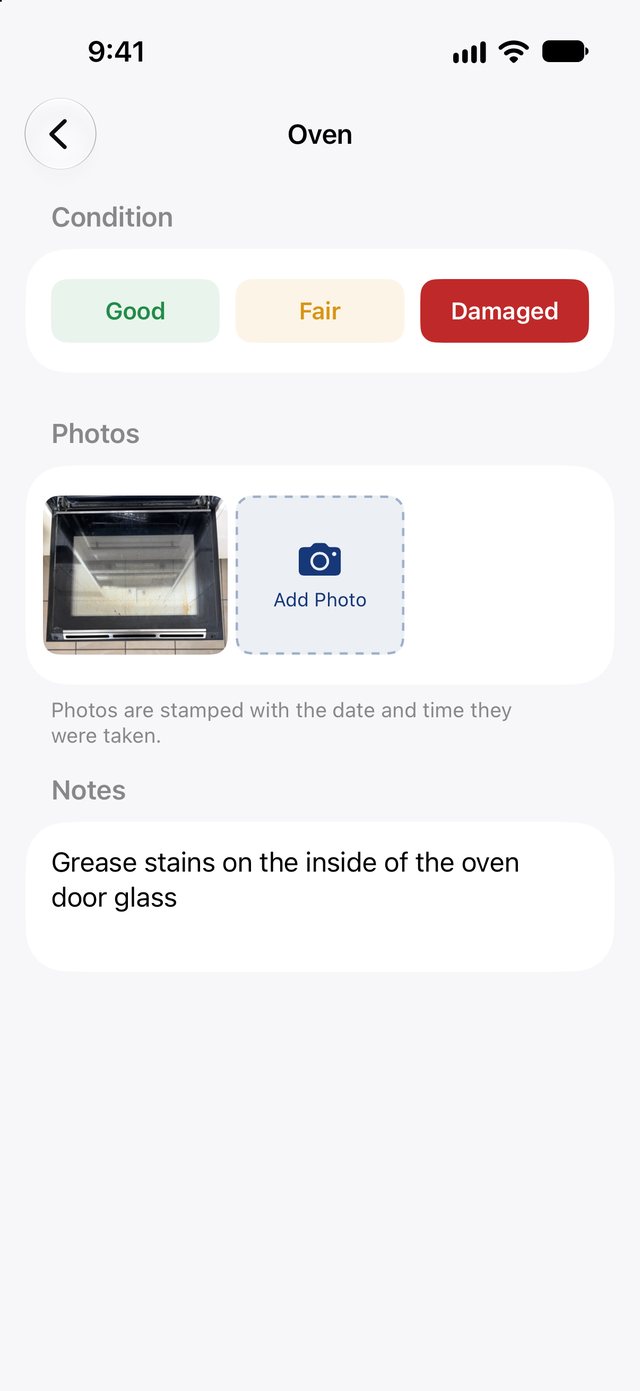
Do your condition report with BondBuddy
BondBuddy is an iPhone app that walks you through each room, stamps every photo with the date and time, and turns it all into a PDF you can send with your condition report. Free for your first 3 rooms.
Download on the App StoreSources (official WA Consumer Protection information, checked 5 November 2026)
- WA Consumer Protection: New bonds process FAQs
- WA Consumer Protection: Property condition reports
- WA Consumer Protection: Releasing a bond
This guide is general information for tenants under standard residential tenancy agreements in WA. It isn't legal advice and rules can change. For your situation, contact WA Consumer Protection or Circle Green Community Legal. BondBuddy is an independent app and is not affiliated with any government body.