How to get your bond back in the ACT
✓ Checked against official ACT Government guidance on 5 November 2026The short version: your bond is held by the ACT Rental Bonds Office. When a refund is requested online, every tenant is notified and has 14 days to respond. If you don't respond, it's paid as requested. If you dispute it, the matter goes to the ACT Civil and Administrative Tribunal (ACAT), and any undisputed part is paid straight away. Return your condition report within 2 weeks, with your own notes and photos.
The whole process at a glance
- Before you move inThe bond can be any amount up to 4 weeks' rent. It's lodged with the Rental Bonds Office.
- When you move inYou receive two signed copies of the condition report.
- Within 2 weeksReturn one signed copy with your amendments, photos or video.
- Moving outLeave it in substantially the same condition and cleanliness, apart from fair wear and tear.
- Refund requestYou're notified and have 14 days to respond. Disputes go to ACAT.
Moving in: the condition report
In the ACT, the landlord or agent gives you two signed copies of the condition report when you move in. You have two weeks to return one signed copy with your amendments. Keep the other.
- Note every problem and disagreement on the report, and attach photos or video.
- No report? Tell the landlord or agent in writing, and make your own.
- The landlord must keep the report for at least a year after the tenancy ends, so you can ask for it in a dispute.
Tip: Do the report before you unpack. Once furniture and boxes cover the floor, you can't photograph the carpet or the skirting boards behind them.
Moving out
You're expected to return the property in substantially the same condition and level of cleanliness, allowing for fair wear and tear. You can't be required to leave it better than it was. Take extra close-up photos of anything raised at the final inspection.
Tip: Photograph every room again after your final clean, from the same angles as your move-in photos. Matching before-and-after photos settle most arguments before they start.
Getting your bond back
- Refunds go through ACT Rental Bonds. When the agent requests a refund online, every tenant on the bond is notified by email or SMS.
- You have 14 days to respond by creating an account and giving your bank details. If you don't respond, the bond is refunded as originally requested.
- Once every tenant approves, everyone is paid as agreed.
- No internet, or overseas? There is a manual Bond Refund Form.
If the landlord claims some of it
- Dispute it within the 14 days. ACT Rental Bonds then refers the matter to ACAT and notifies everyone.
- The undisputed part is paid straight away. Only the amount in dispute waits for ACAT.
- ACAT contacts you directly. It considers the condition of the property at the start and end of the tenancy, and its age and general condition.
- Settled it yourselves? All tenants and the landlord must email rb@act.gov.au, and tell ACAT in writing, so the rest can be refunded.
Fair wear and tear vs damage
Everywhere in Australia, you have to leave the property as you found it, apart from fair wear and tear. Wear and tear is the gradual deterioration from normal use and ageing. You don't pay for it. Damage caused by carelessness, accidents or neglect is different. Typical examples:
| Fair wear and tear | Damage |
|---|---|
| Carpet worn in walkways | Burns or large stains in the carpet |
| Paint or curtains faded by sun | Holes or marks in walls from hanging things without permission |
| Minor scuffs where furniture sat | Benchtop burnt by a hot pan |
| Loose door handles from years of use | Broken window or door from an accident |
The line isn't always obvious, which is why your entry report and dated photos matter so much. A mark that is recorded on day one can't be blamed on you later.
Your bond checklist
- Return the signed, amended condition report within 2 weeks
- Attach photos or video of anything you noted
- Keep your copy for the whole lease
- Leave it as clean and undamaged as you found it
- Watch for the refund email or SMS
- Respond within 14 days with your bank details
- Dispute within 14 days if you disagree
- Bring your report and photos to ACAT
Do your condition report with BondBuddy
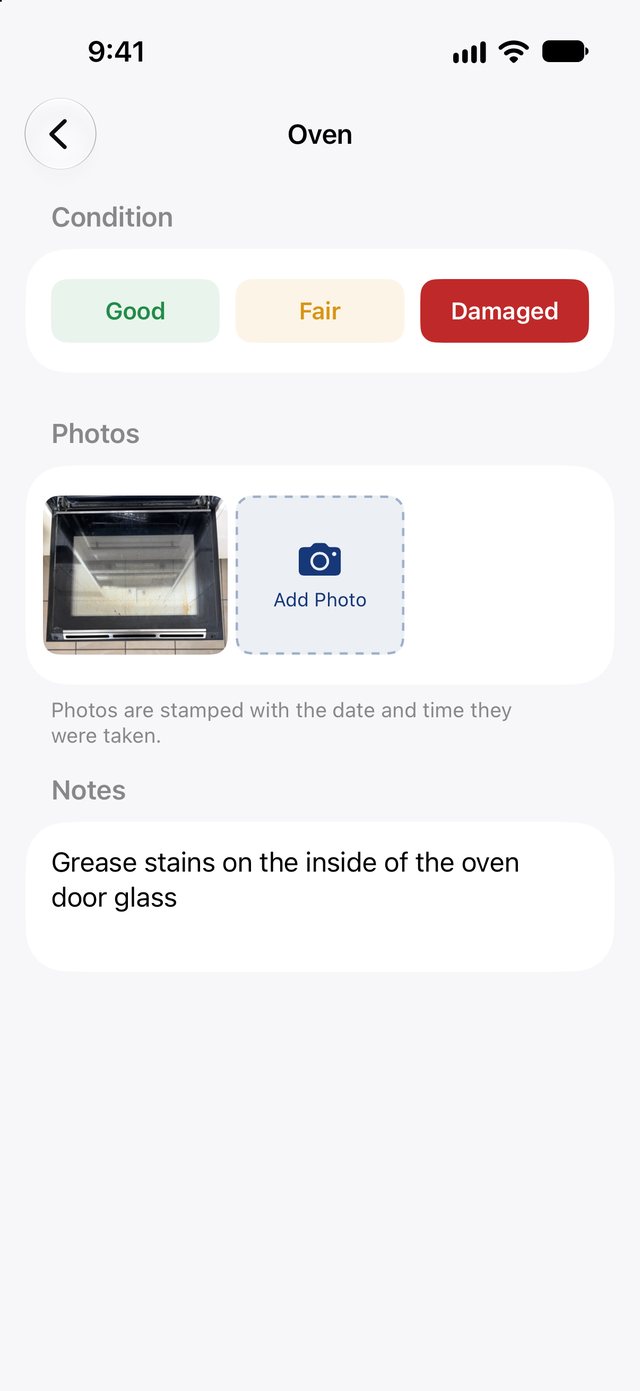
BondBuddy is an iPhone app that walks you through each room, stamps every photo with the date and time, and turns it all into a PDF you can send with your condition report. Free for your first 3 rooms.
Download on the App StoreSources (official ACT Government information, checked 5 November 2026)
- ACT Revenue Office: Rental bonds tenant service
- ACT Revenue Office: About rental bonds
- Legal Aid ACT: Tenancy condition reports
This guide is general information for tenants under standard residential tenancy agreements in the ACT. It isn't legal advice and rules can change. For your situation, contact the Tenancy Advice Service on 1300 402 512 or ACT Rental Bonds. BondBuddy is an independent app and is not affiliated with any government body.